Turkey eSIM Guide: Istanbul Arrival, Cappadocia, and Data Tips
 Gisele8 min read
Photo by Hunanuk, CC0, via Wikimedia Commons.
Istanbul Airport is the size of a small city, and the M11 metro, the taxi rank, and the Havaist bus stands all sit in different parts of it. Walk past passport control with a tired phone and the trip starts making decisions for you: which transfer is fastest, which side of the Bosphorus your hotel is on, and whether the driver who waved you over is using a meter.
This Turkey eSIM guide has the practical version first: install before you fly, switch your phone's data line after you land, keep your home line available for bank texts, and download offline maps before any Cappadocia or coastal transfer day. A SIM kiosk inside arrivals still works, but it costs extra time and lira you do not want to spend on day one.
Quick answer for travelers
| Decision | Best move in Turkey |
|---|---|
| When to install | Before departure, on home WiFi |
| When to activate data | After landing in Turkey |
| First real use case | Istanbul Airport transfer, hotel check-in, maps, translation |
| Apps that matter on day one | BiTaksi, Apple Maps or Google Maps, WhatsApp, Istanbulkart top-up |
| Trip style that needs the most data | Multi-stop Istanbul plus Cappadocia plus coast with photos and hotspot use |
| Sensible one-week range | 5-10 GB for normal use, more for hotspot or video |
| Only eSIM plan page | Turkey eSIM plans |
If eSIMs are still new to you, read our plain-English guide to what an eSIM is. If you already bought a plan and want a clean install flow, use how to install and activate an eSIM before you leave home.
Will an eSIM work well in Turkey?
Yes, with one caveat. Istanbul, the Aegean and Mediterranean coast resort regions, and the Cappadocia core route are the easy part. The places where signal dips are predictable: long stretches between hill towns, deep parts of the Marmaray Bosphorus tunnel, the valley floors during a Cappadocia balloon flight, and ferry crossings on the Sea of Marmara.
Turkey's three mobile networks are Turkcell, Vodafone Turkey, and Türk Telekom Mobil, and most travel eSIMs route through one of them. Coverage is reliable across the major cities and resort areas. A data-only plan is enough for most Turkey trips: WhatsApp, Apple Maps or Google Maps, BiTaksi, hotel messages, balloon-company confirmations, translation, and the museum-card and city-pass apps that mostly run over data. Keep your home SIM active for bank texts if you rely on them.
Apple's current support page explains how to set up eSIM on iPhone. Google documents dual SIM and eSIM behavior on Pixel phones. For Samsung and other Android phones, the menu names vary, but the idea is the same: add the eSIM, label it, choose which line handles data, and turn on data roaming when the plan instructions tell you to.
Set it up before your airport transfer
Istanbul has two airports, and they are not interchangeable. Istanbul Airport (IST) sits on the European side, with M11 metro and Havaist bus links into the city center. Sabiha Gokcen (SAW) is on the Asian side, longer to most central hotels, and best paired with the Havabus or a metered taxi. Whichever airport you land at, you want the data line working before you decide which transfer to take.
Use this checklist:
- Buy the Turkey plan before your flight.
- Install the eSIM on steady home WiFi.
- Label the line "Turkey" so it is obvious in your cellular settings.
- Keep your home line as default for calls and bank texts if you need them.
- After landing, set the Turkey eSIM as your cellular data line and enable data roaming if your provider's instructions say to.
If data does not work after a few minutes, do not panic-reinstall the eSIM. Check the boring settings first: the right data line, roaming on, airplane mode toggled off and on, and APN only if your provider gives you one. Our eSIM troubleshooting guide covers the usual fixes.
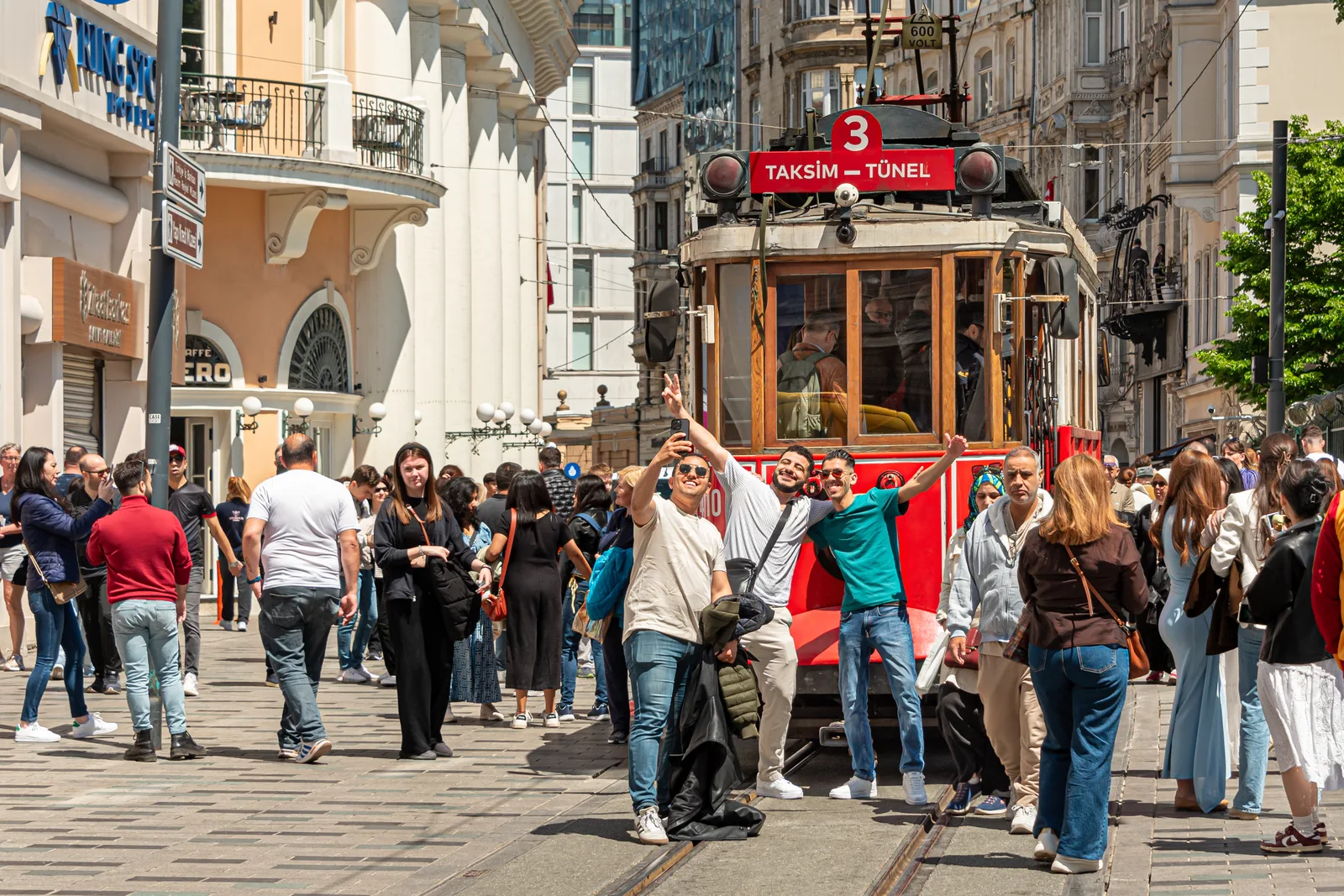
Istiklal Avenue, the Galata side streets, and tram routes through Sultanahmet are easier when maps, messaging, ride apps, and translation keep working between transfers.
Where Turkey actually uses your data
Istanbul earns the line on a phone bill. You will use data for ferry timing across the Bosphorus, tram routes through Sultanahmet, walking directions through Karakoy and Galata's narrow streets, BiTaksi rides when traffic on the bridges turns a 6 km trip into a 90-minute crawl, translation when a sign or menu only appears in Turkish, and hotel messages when check-in shifts because of traffic. The headline sights are Hagia Sophia, the Blue Mosque (Sultan Ahmed Mosque), Topkapi Palace, the Grand Bazaar, the Spice Bazaar, the Galata Tower, Dolmabahce Palace, and Kadikoy on the Asian side for a calmer afternoon. Almost every transition between them goes faster when your phone is online.
Cappadocia is a different rhythm. Most travelers fly into Kayseri (ASR) or Nevsehir (NAV) and transfer to Goreme, Uchisar, or Urgup. Hotels message pickup confirmations the night before. Balloon companies message weather-clearance and pickup window in the early morning, often before 5 a.m. The trail network for hiking valleys like Pigeon Valley and Rose Valley is far easier with a saved offline map than with cellular alone. Reception around Goreme is generally fine, but you do not want it as your only plan during sunrise.

In Cappadocia, hotel pickups, balloon-company weather calls, and offline trail maps matter more than constant streaming. Download routes the night before any sunrise.
Coastal Turkey adds a third version of the same problem. Around Antalya, Bodrum, Fethiye, Kas, Cesme, and Izmir, you will use data for beach-to-town rides, ferry checks across to Greek islands like Rhodes, Symi, or Chios, restaurant bookings, and finding your way back from a late dinner along uneven streets. Dalaman (DLM) and Antalya (AYT) are the workhorse coastal arrival airports.
Turkey-specific habits that save money and time
Turkey rewards travelers who plan the first hour and stay flexible after. A few habits help.
- Buy an Istanbulkart at a vending machine in any metro or tram station. It works on the metro, tram, Marmaray, ferries, funiculars, and most buses, and a single card per traveler is much cheaper than per-ride QR tickets. The Marmaray rail line crosses under the Bosphorus and connects Halkali on the European side with Gebze on the Asian side via Sirkeci and Yenikapi, the most useful long route across the city.
- Use BiTaksi or call a metered taxi rather than flagging one curbside. If a driver waves off the meter (taksimetre), step out before the trip starts. The "100 lira note swap" trick, where the driver shows you what looks like a 5 lira note before claiming you handed it over, is the most common Istanbul taxi scam, so pay in exact change or by card when the option exists.
- Skip the shoe-shiner who drops a brush in front of you in Sultanahmet. Picking it up triggers a "thank you, let me shine yours" pitch with an inflated price at the end. A polite refusal and a short walk works.
- In Sultanahmet, the Grand Bazaar, and the Spice Bazaar, treat carpet, leather, or hookah-shop tea invitations as the start of a sales pitch, not a friendly chat. Bargaining is normal, walking out is normal, and no shop expects a yes on the first visit.
- Hagia Sophia has been a working mosque since 2020. Wear modest clothing, women should bring a light scarf for the head, and skip the visit during prayer times when the upper gallery for non-worshippers is closed. The Blue Mosque follows the same etiquette.
- Treat the approach to Taksim Square, Istiklal Avenue, the Grand Bazaar, the Galata Bridge, and big football match days as bag-watch zones. The U.S. State Department currently lists Turkey at Level 2: Exercise increased caution, and specifically tells travelers to be vigilant in crowded public spaces and transportation hubs.
- Use mobile data, not random cafe WiFi, for account logins, bank apps, or 2FA messages. Our airport WiFi vs eSIM guide explains why public WiFi is a backup, not your main plan.
Food planning is another quiet data use. Leave room for simit from a street cart in the morning, balik ekmek from a boat near the Galata Bridge, manti dumplings on a tired afternoon, lahmacun and pide on travel days, kebab in Beyoglu, and a long baklava and Turkish coffee stop after dinner. Working data helps less with finding food in general and more with avoiding the one tourist trap that is convenient because you are hungry and lost.
How much data do you need in Turkey?
Most Turkey travelers do not need a giant plan unless they are uploading video, sharing a hotspot, or working remotely. Maps, messaging, ride apps, translation, and tickets are steady but not large. Long bus rides, photo and video backup, and streaming during balloon transfers or coastal ferry crossings are what move the math.
| Trip style | Sensible starting point |
|---|---|
| Light: maps, messaging, translation, hotel apps | 0.5-1 GB per day |
| Normal tourist: routes, BiTaksi, photos, social browsing | 1-2 GB per day |
| Heavy: hotspot, video uploads, streaming, remote work | 3+ GB per day |
For most one-week Istanbul plus Cappadocia trips, 5 to 10 GB is the practical range. Size up if you will hotspot a laptop, post Reels daily, share data with another device, or use cellular as your main connection at a hotel with weak WiFi. If you want the longer breakdown, our guide to how much data you need when traveling walks through the common app categories.
Bottom line
A Turkey eSIM is mainly an arrival-day, transfer-day, and balloon-morning tool. It keeps maps, ride apps, translation, ticket scans, and booking confirmations working when the trip jumps from Istanbul to Cappadocia, then to a coastal town, then home.
Install before departure, switch your data line after landing, keep your home SIM available for bank texts, and download offline maps before any Cappadocia or coastal transfer day. If Turkey is your next stop, Only eSIM's Turkey plans are the easiest place to start. If you are continuing on, our Italy eSIM guide, Japan eSIM guide, and Thailand eSIM guide follow the same setup logic with country-specific tips.
Stay connected wherever you travel
Instant-activation eSIM plans for 190+ countries. No SIM swaps. No roaming charges.
Photos: hero image by Hunanuk, CC0, via Wikimedia Commons. Istanbul street photo by Jorge Franganillo, CC BY 2.0, via Wikimedia Commons. Cappadocia balloon photo by MusikAnimal, CC BY-SA 4.0, via Wikimedia Commons.
🇹🇷 Ready to connect in Turkey?
Instant-activation eSIM plans for Turkey. No SIM swaps. No roaming charges.
Related Articles
 Destinations
Italy eSIM Guide: Rome Arrival, Train Trips, and Data Tips
A practical Italy eSIM guide for landing in Rome or Milan, riding Frecciarossa and Italo between cities, validating regional tickets, dodging piazza scams, and sizing data for Rome, Florence, Venice, Milan, and Naples.
Gisele8 min read Destinations
South Korea eSIM Guide: Seoul, Setup, Transit, and Data Tips
A practical South Korea eSIM guide for travelers: when to install, what to expect on Korean networks, Seoul transit tips, data sizing, and what to do before landing.
 Mia7 min read
 Destinations
Thailand eSIM Guide: Setup, Bangkok Transit, and How Much Data You Need
A practical Thailand eSIM guide for travelers who want data working before they leave the airport, plus setup tips, Bangkok transit advice, scam awareness, and realistic data sizing for islands, cities, and cafe days.
Mia8 min read